

Mission Overview
Map of Observations

Wavelength Coverage

NOTE: The K2 mission is a follow-on to the Kepler mission, operated when the telescope was reduced to two reaction wheels.
The K2 mission observed 100 square degrees for 80 days, each across 20 different pointings along the ecliptic. The mission began when the original Kepler mission ended due to the loss of the second reaction wheel in 2013. The design of the K2 mission needed to periodically change the telescope's pointing to sample a variety of Galactic sight lines to maintain a reasonable pointing stability, balanced via the solar wind. While the mission continued to observe stars to detect transiting exoplanets, the variety of pointings enabled a wider variety of astrophysical research projects; in fact, the K2 mission was fully Guest Investigator-driven. The mission produced the same pixel-level and lightcurve data products as the original Kepler mission, however, the mission's planet search pipeline was not run. A number of community-contributed lightcurves with pointing drift errors greatly mitigated were provided as High Level Science Products, and can complement the mission data in many science cases.
Active From
Feb. 4, 2014 - Sept. 26, 2018
Resolution
4 arcseconds / pixel
Capabilities
- Time Series
- Photometry
- Imaging
Data Availability
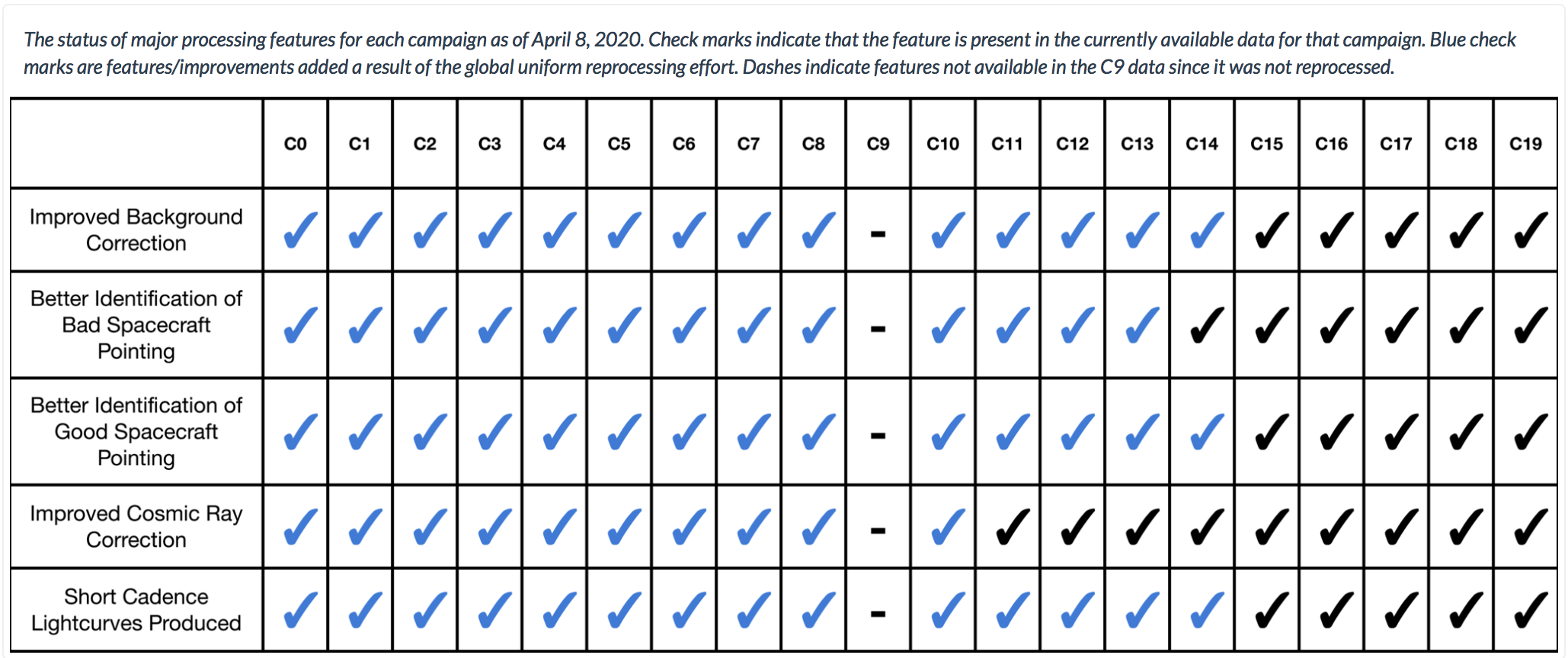
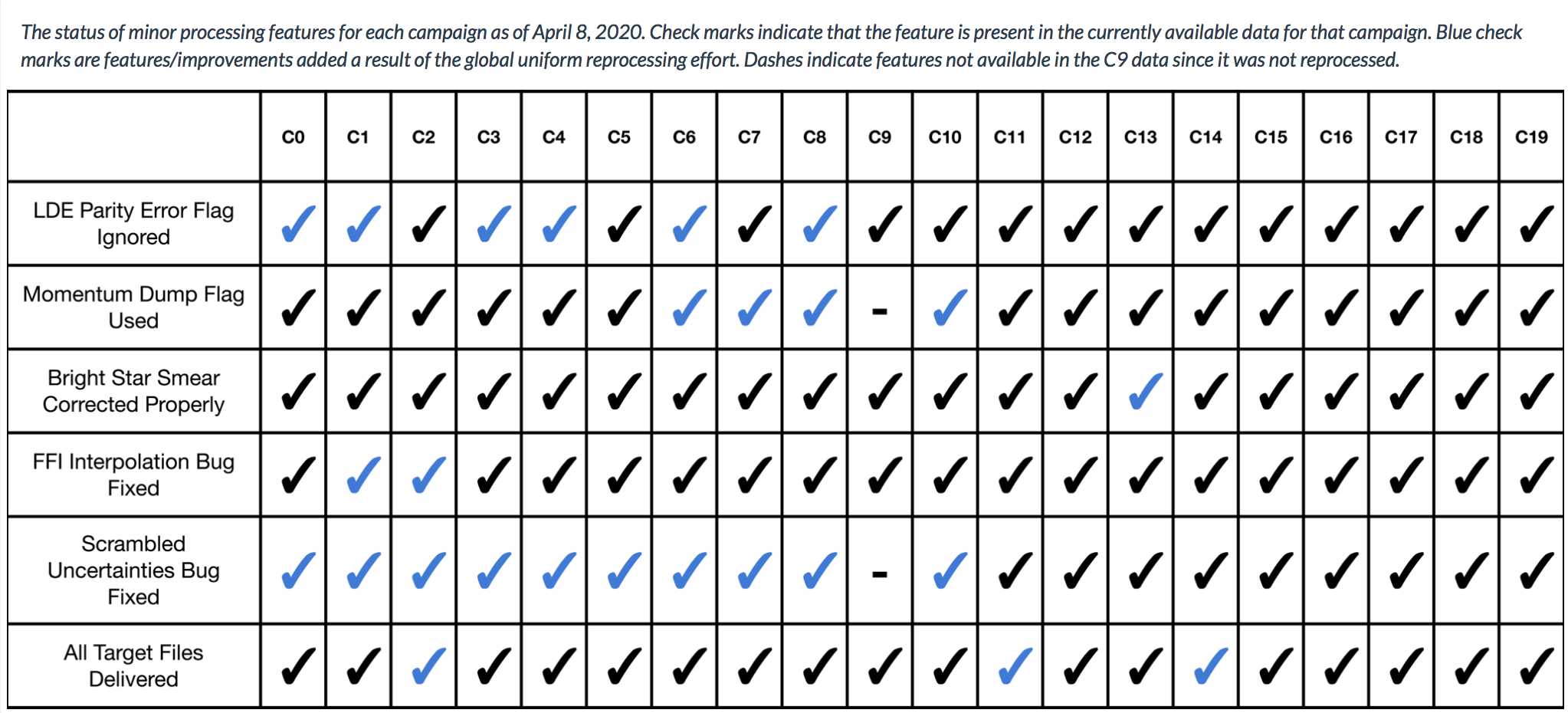
Consult the K2 reprocessing status tables (Major and Minor) for each Campaign. Blue means done in a re-processed version, black means done from first release.
Documentation
All DocumentsK2 Handbook
August 24, 2020
The K2 Handbook describes the engineering challenges and mitigation strategies of the K2 mission. It should be used in conjunction with the Kepler Archive Manual, Kepler Instrument Handbook, and Kepler Data Characteristics Handbook.
-
Release Notes
June 10, 2020
-
K2 Campaign Footprints
September 10, 2020
-
Kepler Python Notebook Tutorials
September 23, 2020
-
exo.MAST

Find and download exoplanet parameters, data visualizations, and MAST holdings by exoplanet.
-
Bulk Downloads

Download scripts to retrieve complete sets of K2 data, such as light curves, target pixel files, full frame images, or engineering files.
-
Mission Related Software

This table is a curated list of software commonly used by the science community during the Kepler and K2 missions.


Featured Data Products
All K2 Data Products


K2 Images
Slideshow
Field of view for all campaigns

Supernova Cosmology Experiment Patch

K2 Science Overview

Image Credit: NASA Ames/W. Stenzel
How K2 worked. Image Credit: NASA Ames/W. Stenzel

Image Credit: NASA Ames/W. Stenzel