

Mission Overview
The Hubble Arp Galaxy Survey (HAGS)
Primary Investigator: Julianne J. Dalcanton
HLSP Authors: Julianne J. Dalcanton, Meredith J. Durbin, Benjamin F. Williams
Released: 2025-09-12
Updated: 2025-09-12
Primary Reference(s): Dalcanton et al. 2025
DOI: 10.17909/176w-p735
Citations: See ADS Statistics
Source Data:
- Source Data DOI: 10.17909/htjd-bj10
- HST SNAP 15446
Overview
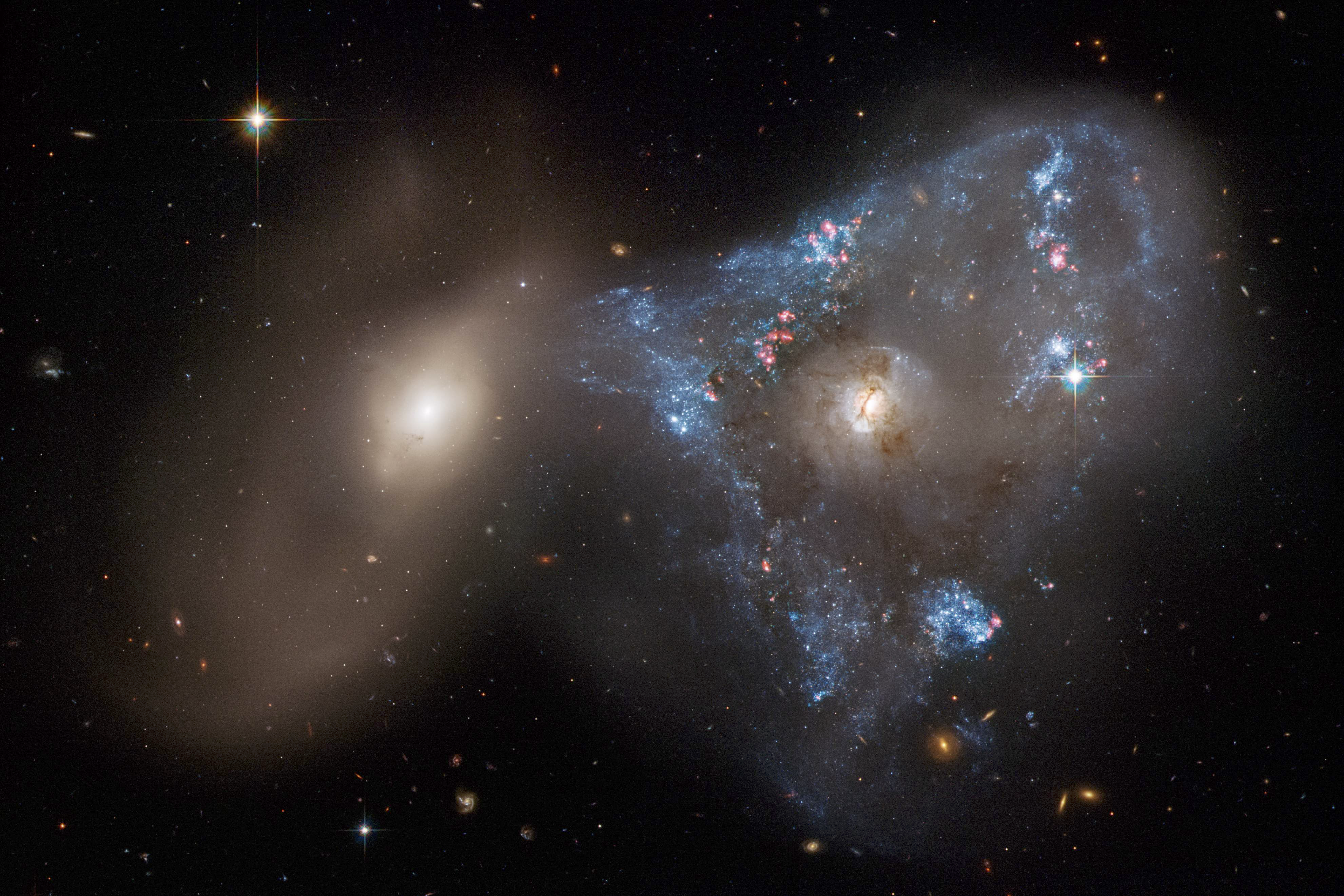
The Hubble Arp Galaxy Survey is an atlas of 216 new optical F606W images of systems drawn from the Arp (1966) and Arp & Madore (1987) catalogs of peculiar galaxies. The images were collected through a "gap-filler" program (SNAP-15446; PI: Dalcanton) that used shorter than average orbits, drawing targets from the Arp catalogs that lacked imaging and were well-matched to ACS/WFC's large field of view.
The resulting galaxy images display rich morphologies, revealing a variety of massive stars, HII regions, stellar clusters, dust lanes, tidal tails, backlit galaxies, and occasional chance superpositions. The atlas images provide a superb starting point for more detailed studies with high-resolution imaging in other wavelengths, and spectroscopy to track kinematics and the interstellar medium (ISM). Areas of obvious scientific relevance include feedback and star formation in merging and interacting galaxies, resolved stellar populations at the extremes of stellar density, the properties of young massive stars and stellar clusters, the physics of the cold ISM and dust, and stellar and gas dynamics.
This repository includes the reduced images and catalogs of point-source photometry presented in Dalcanton et al. 2025. A shorter atlas-form PDF of the images is available on Zenodo at DOI:10.5281/zenodo.16778896.
Data Products
Image Files
Cosmic-ray cleaned, drizzled images are named as:
hlsp_hags_hst_acs_<TARGNAME>_f606w_v1_drz.fits
where:
- where <TARGNAME> is the name of the target and has the form: arp?, arp??, arp???, arp-madore????-???, or arp-madore????-????
Photometry Catalog
Point source photometry for the entire sample is compiled in a single FITS table file:
Measurements for a specific target can be selected using the "TARGNAME" column.
In the point source photometry file, after a single header line, each subsequent line corresponds to a single source, and includes the combined F606W photometry and the photometry for each of the two individual sub-exposures, along with various quality metrics and bookkeeping quantities returned by hst1pass. Quantities measured within each of the two sub-exposures are followed by a "_1" or "_2" subscript. Empty field entries or "-1" are used as placeholders for detections in only a single exposure, which typically correspond to point sources in the chip gap or near the edges of the images. When a source was detected in two exposures, the reported merged quantities are unweighted averages.
The columns in the photometry file are as follows:
| Column Name | Description |
|---|---|
| TARGNAME | Name of target in catalog (ARP?, ARP??, ARP???, ARP-MADORE????-???, or ARP-MADORE????-????) |
| ROOTNAME | Root name of image (jdrz* for detection in a single image, or jdrz*_jdrz* for detections in two images) |
| RA | Right ascension of source in decimal degrees |
| DEC | Declination of source in decimal degrees |
| X | X position on the image (average of X_1, X_2 if detected in both exposures) |
| Y | Y position on the image (average of Y_1, Y_2 if detected in both exposures) |
| F606W_VEGA | Vega magnitude in ACS/WFC F606W filter |
| F606W_Q | PSF-weighted absolute sum of the PSF fit residuals (zero = perfect fit) |
| F606W_ERR | photo- and astrometric uncertainty estimate in magnitudes/pixels |
| F606W_COUNT | counts in the source |
| F606W_SKY | counts in the subtracted sky background |
| F606W_CHI | chi-square of the PSF fit ("-c" output in hst1pass) |
| F606W_SHARP | sharpness of the PSF fit ("-C" output in hst1pass) |
| F606W_NSAT | number of saturated pixels within source ("-n" output in hst1pass) |
| F606W_CROWD | fraction of flux in aperature from possible neighbors ("-o" output in hst1pass) |
| F606W_MAXCROWD | "super conservative" value of F606W_CROWD ("-O" output in hst1pass) |
| CHIP | number of the ACS chip the source was detected on (1 or 2) |
| ROOTNAME_1 | Root name of image #1 (jdrz* if detected in image #1, blank if not) |
| ROOTNAME_2 |
Root name of image #2 (jdrz* if detected in image #2, blank if not) |
| RA_1 | RA of source in image #1 (-1.0 if undetected in image #1) |
| RA_2 | RA of source in image #2 (-1.0 if undetected in image #2) |
| DEC_1 | Dec of source in image #1 (-1.0 if undetected in image #1) |
| DEC_2 | Dec of source in image #2 (-1.0 if undetected in image #2) |
| X_1 | X position of source in image #1 (-1.0 if undetected in image #1) |
| X_2 | X position of source in image #2 (-1.0 if undetected in image #2) |
| Y_1 | Y position of source in image #1 (-1.0 if undetected in image #1) |
| Y_2 | Y position of source in image #2 (-1.0 if undetected in image #2) |
| F606W_VEGA_1 | F606W magnitude of source in image #1 (-1.0 if undetected in image #1) |
| F606W_VEGA_2 | F606W magnitude of source in image #2 (-1.0 if undetected in image #2) |
| F606W_Q_1 | PSF-weighted absolute sum of the PSF fit residuals for measurement in image #1 (-1.0 if undetected in image #1) |
| F606W_Q_2 | PSF-weighted absolute sum of the PSF fit residuals for measurement in image #2 (-1.0 if undetected in image #2) |
| F606W_ERR_1 | uncertainty in magnitudes/pixels for measurement in image #1 (-1.0 if undetected in image #1) |
| F606W_ERR_2 | uncertainty in magnitudes/pixels for measurement in image #2 (-1.0 if undetected in image #2) |
| F606W_COUNT_1 | counts in the source detected in image #1 (-1.0 if undetected in image #1) |
| F606W_COUNT_2 | counts in the source detected in image #2 (-1.0 if undetected in image #2) |
| F606W_SKY_1 | counts in the subtracted sky in image #1 (-1.0 if undetected in image #1) |
| F606W_SKY_2 | counts in the subtracted sky in image #2 (-1.0 if undetected in image #2) |
| F606W_CHI_1 | chi-square of the PSF fit in image #1 (-1.0 if undetected in image #1) |
| F606W_CHI_2 | chi-square of the PSF fit in image #2 (-1.0 if undetected in image #2) |
| F606W_SHARP_1 | sharpness of the PSF fit in image #1 (-1.0 if undetected in image #1) |
| F606W_SHARP_2 | sharpness of the PSF fit in image #2 (-1.0 if undetected in image #2) |
| F606W_NSAT_1 | number of saturated pixels within source in image #1 (-1.0 if undetected in image #1) |
| F606W_NSAT_2 | number of saturated pixels within source in image #2 (-1.0 if undetected in image #2) |
| F606W_CROWD_1 | crowding of the source in image #1 (-1.0 if undetected in image #1) |
| F606W_CROWD_2 | crowding of the source in image #2 (-1.0 if undetected in image #2) |
| F606W_MAXCROWD_1 | "super conservative" value of F606W_CROWD_1 (-1.0 if undetected in image #1) |
| F606W_MAXCROWD_2 | "super conservative" value of F606W_CROWD_2 (-1.0 if undetected in image #2) |
| CHIP_1 | ACS chip number of detection (1 or 2 if detected, -1 if undetected) |
| CHIP_2 | ACS chip number of detection (1 or 2 if detected, -1 if undetected) |
Data Access
MAST Portal and Astroquery
The HAGS data products are available in the MAST Search Portal (web-based, cross-mission search interface) and Astroquery (Python package to search for and download files from Python scripts you write).
- In the MAST Search Portal, set the Provenance Name filter to "HAGS" in an Advanced Search to find these data. The user guide for how to search and download products using the MAST Portal is available here.
- For Astroquery, the following example code demonstrates how to search for and download these products. This code assumes that you want to download all products from this HLSP, so you may want to consider narrowing down your search for large HLSPs (> 10 GB) or those with many individual files (> 10k). You can find more astroquery.mast tutorials here.
from astroquery.mast import Observations
# Search for all HAGS products
all_obs = Observations.query_criteria(provenance_name="hags")
data_products = Observations.get_product_list(all_obs)
# Print the number of data products that would be downloaded
print(len(data_products))
# Download data
Observations.download_products(data_products)
-
A web-based interface for cross-mission searches of data at MAST or the Virtual Observatory.
-
Search for and download data products for this HLSP programmatically in Python.


Citations
Please remember to cite the appropriate paper(s) below and the DOI 10.17909/176w-p735 if you use these data in a published work.
Note: These HLSP data products are licensed for use under CC BY 4.0.