

Mission Overview
Olin Wilson Legacy Survey (OWLS)
Primary Investigator: Brett M. Morris
HLSP Authors: Brett M. Morris, Leslie Hebb, Suzanne L. Hawley, Kathryn Jones, Jake Romney
Released: 2025-08-20
Updated: 2026-03-11
Primary Reference(s): Morris et al. 2025
DOI: 10.17909/vet0-jg24
Citations: See ADS Statistics

Overview
The Olin Wilson Legacy Survey (OWLS; Morris et al 2025) presents spectroscopic observations from a planned 10 year survey of Ca II H & K emission, using observations made with the ARC 3.5m Telescope at Apache Point Observatory. The primary goal of the survey is to investigate activity cycles in low mass stars. The sample includes stars chosen from the legacy Mount Wilson survey carried out by Olin Wilson more than 50 years ago, together with newly identified planet-host stars and a select sample of early-mid M dwarfs. This collection of spectral time-series presents the first four years of data, with more than 1037 observations of 270 stars, with a specific focus on K and M stars. The team identifies a subsample of 153 stars for continuing observations over the full 10 year survey. The ultimate goal is to link the activity cycle and rotation periods in a robust sample of stars spanning FGKM spectral types and to investigate the implications for the underlying magnetic dynamo.
Data Products
The v1.0 release of OWLS is composed of 1037 optical spectra collected from the ARC 3.5 m Telescope at Apache Point Observatory with the ARC Echelle Spectrograph (ARCES), which has a spectral resolution R~31,500.
Data products are organized into FITS files with single-epoch echelle spectra containing 107 spectral orders, spanning roughly from 3500 Angstroms to 10611 Angstroms. The names of each FITS file follow the form:
hlsp_owls_apo_arces_<target>-<datetime>_clear_v1.0_spec.fits.gz
where:
-
<target> is the name of the target star,
-
<datetime> is the UTC start date and time of the exposure, in the format "YYYY-MM-DD-hh-mm" (year, month, day, hour, and minute, separated by dashes).
Within the gzipped FITS file, the Primary HDU contains the FITS header for the MULTISPEC FITS file produced by the reduction process in IRAF. All other extensions in the file are BinTableHDUs containing two columns: "WAVELENGTH" in Angstroms and "FLUX" in ADU. There is one BinTableHDU extension for each of the 107 spectral orders. ORDER_001 or ext=1 contains the reddest spectral order, and mean wavelengths decrease with increasing order number.
A spectrum of standard star HZ 44 is also included for use in continuum normalization, with the name:
hlsp_owls_apo_arces_hz44-2024-06-19-03-34_clear_v1.0_spec.fits.gz
Data Access
MAST Portal and Astroquery
The OWLS data products are available in the MAST Search Portal (web-based, cross-mission search interface) and Astroquery (Python package to search for and download files from Python scripts you write).
- In the MAST Search Portal, set the Provenance Name filter to "OWLS" in an Advanced Search to find these data. The user guide for how to search and download products using the MAST Portal is available here.
- For Astroquery, the following example code demonstrates how to search for and download these products. This code assumes that you want to download all products from this HLSP, so you may want to consider narrowing down your search for large HLSPs (> 10 GB) or those with many individual files (> 10k). You can find more astroquery.mast tutorials here.
from astroquery.mast import Observations
# Search for all OWLS products
all_obs = Observations.query_criteria(provenance_name="owls")
data_products = Observations.get_product_list(all_obs)
# Print the number of data products that would be downloaded
print(len(data_products))
# Download data
Observations.download_products(data_products)
-
A web-based interface for cross-mission searches of data at MAST or the Virtual Observatory.
-
Search for and download data products for this HLSP programmatically in Python.


Code Examples
The authors of OWLS have provided the following code examples for working with the data in Python, shown below.
How to Open the Spectra Files
If you open the FITS files, you will find one BinTable extension for each of the 107 spectral orders. ORDER_001 or ext=1 contains the reddest spectral order, and mean wavelengths decrease with increasing order number.
Here is a code snippet that opens one of the spectra files using Python:
>>> from astropy.io import fits
>>> from specutils import SpectrumList

# Display file information
>>> filename = "hlsp_owls_apo_arces_hz44-2024-06-19-03-34_clear_v1.0_spec.fits.gz"
>>> fits.info(filename)

 Filename: hlsp_owls_apo_arces_hz44-2024-06-19-03-34_clear_v1.0_spec.fits.gz
    No.    Name      Ver    Type      Cards   Dimensions   Format
      0  PRIMARY       1 PrimaryHDU      75   ()
      1  ORDER_001     1 BinTableHDU     18   1651R x 2C   [D, E]
      2  ORDER_002     1 BinTableHDU     18   1651R x 2C   [D, E]
      3  ORDER_003     1 BinTableHDU     18   1651R x 2C   [D, E]
      ...

# Read all spectral orders
>>> echelle_orders = SpectrumList.read(filename)
Demo Notebook: Barycentric Correction and Continuum Normalization
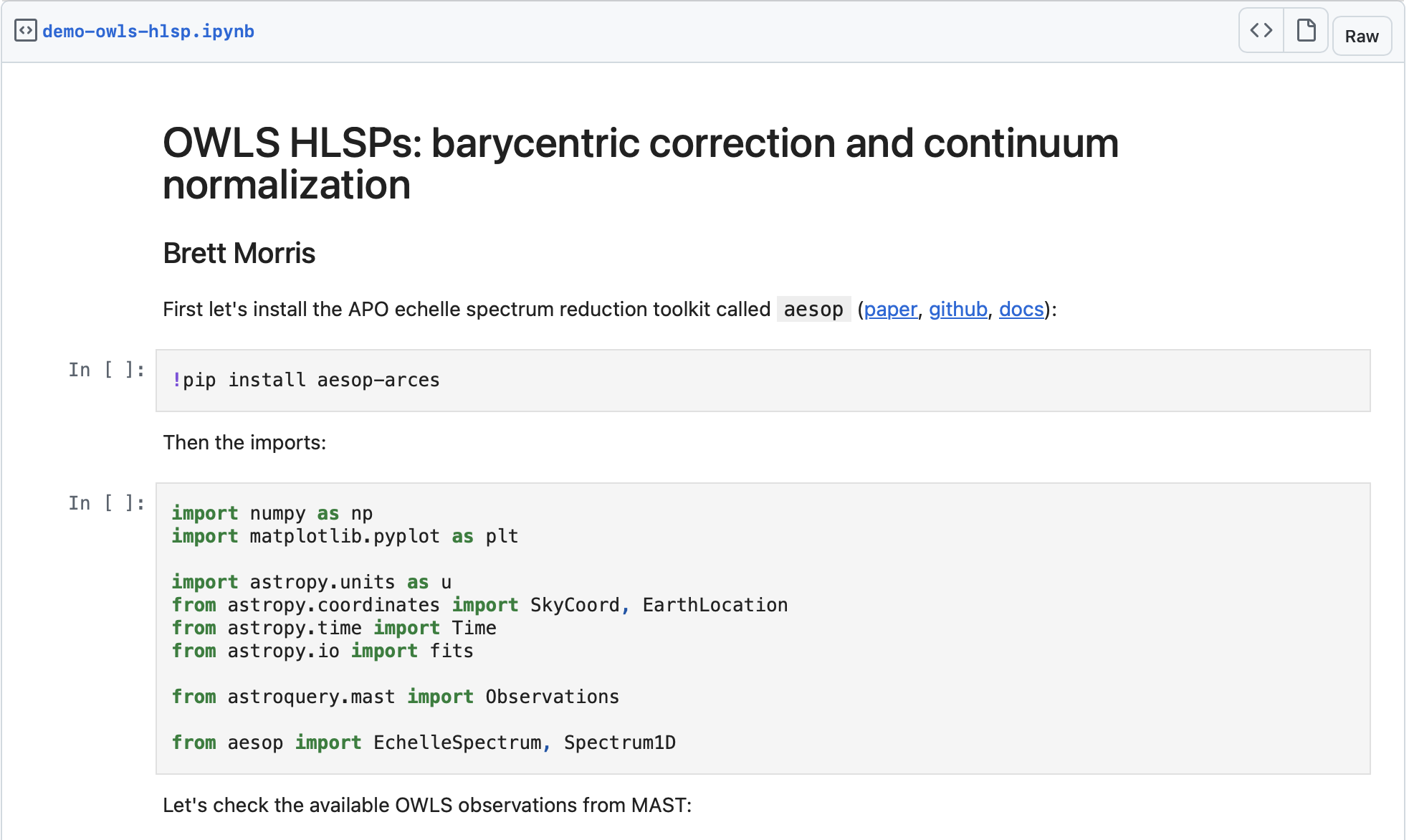
The team has also provided this Jupyter Notebook Tutorial showing how to download the data, apply barycentric velocity correction, and blaze normalize the spectra for analysis.
OWLS Demo Notebook
Jupyter notebook tutorial showing how to open, blaze normalize, and apply barycentric corrections to OWLS spectra.
Citations
Please remember to cite the appropriate paper(s) below and the DOI (10.17909/vet0-jg24) if you use these data in a published work.
Note: These HLSP data products are licensed for use under CC BY 4.0.