


 Follow Us

|

About IMAPS
- Introduction, Description and History of IMAPS-1 - from the paper "High Resolution Spectroscopy in the Far-UV: Observations of the Interstellar Medium by IMAPS on ORFEUS-SPAS by Jenkins,Reale, Zucchino,Sofia (1996,
- Kluwer Academic Publishers).
- Instrument Description
- from above paper
- Preparations for IMAPS-2 - from above paper
Mission
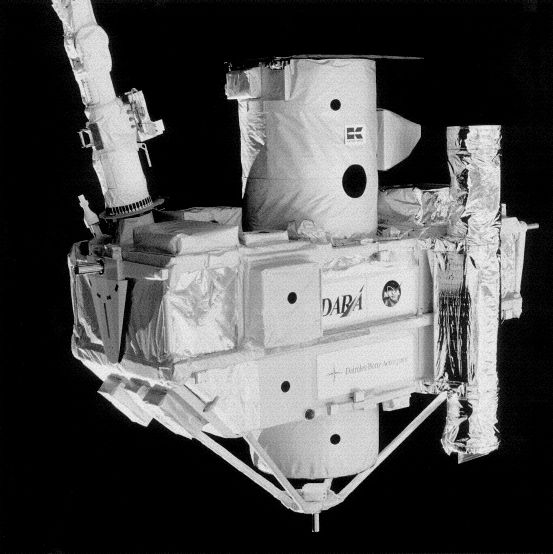 The Interstellar Medium Absorption Profile Spectrograph (IMAPS)
flew on its first Shuttle-launched mission in September 1993, as
part of the ORFEUS-SPAS program sponsored jointly by NASA and the German
Space Agency (DARA). A second shuttle flight (i.e., as part of
the ORFEUS-SPAS II mission), occurred in November 1996, aboard the
shuttle Columbia.
The objective-grating echelle spectrograph was designed to
obtain high resolution spectra
of bright stars in the 950-1150 Å wavelength region;
a region not detectable by HST.
IMAPS is capable of producing spectra with a resolution of R = 240,000
(i.e., corresponding to a doppler shift of ~ 1 km/sec),
making it the highest resolution spectrograph ever flown in space.
The Interstellar Medium Absorption Profile Spectrograph (IMAPS)
flew on its first Shuttle-launched mission in September 1993, as
part of the ORFEUS-SPAS program sponsored jointly by NASA and the German
Space Agency (DARA). A second shuttle flight (i.e., as part of
the ORFEUS-SPAS II mission), occurred in November 1996, aboard the
shuttle Columbia.
The objective-grating echelle spectrograph was designed to
obtain high resolution spectra
of bright stars in the 950-1150 Å wavelength region;
a region not detectable by HST.
IMAPS is capable of producing spectra with a resolution of R = 240,000
(i.e., corresponding to a doppler shift of ~ 1 km/sec),
making it the highest resolution spectrograph ever flown in space.
The NASA photo above shows the ORFEUS-SPAS II platform prior to being launched from the NASA Space Shuttle COLUMBIA. IMAPS is the long shiny tube seen piggy-backed on the right side of the platform. (Clicking on the image will show an expanded view.) The other 2 instruments on baord ORFUES-SPAS which share a single main telescope, include the Berkeley Extreme Ultraviolet Spectrometer (EUV) provided by the University of California at Berkeley, and the Far-Ultraviolet Echelle Spectrograph (FUV) designed by the University of Tubingen and the Landessternwarte Heidelberg.
The IMAPS Science Team included the following:
- Dr. Edward Jenkins (Princeton University Observatory) -
Principal Investigator
- Dr. Charles Joseph (Rutgers University, Physics and Astronomy) IMAPS-1,
- Dr. Ulysses Sofia (Villanova University, Astronomy and Astrophysics),
- Dr George Sonneborn (NASA/Goddard Space Flight Center, LASP)
- Dr. Charles Joseph (Rutgers University, Physics and Astronomy) IMAPS-1,
 |
|
|
|
|
|
|
|
|
|