


 Follow Us

|

Far Ultraviolet Spectroscopic Explorer
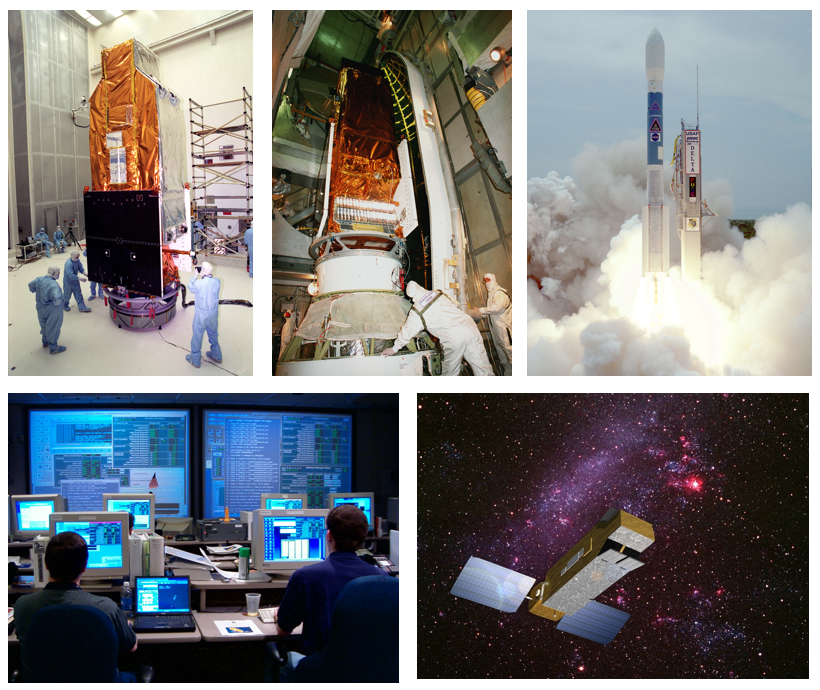
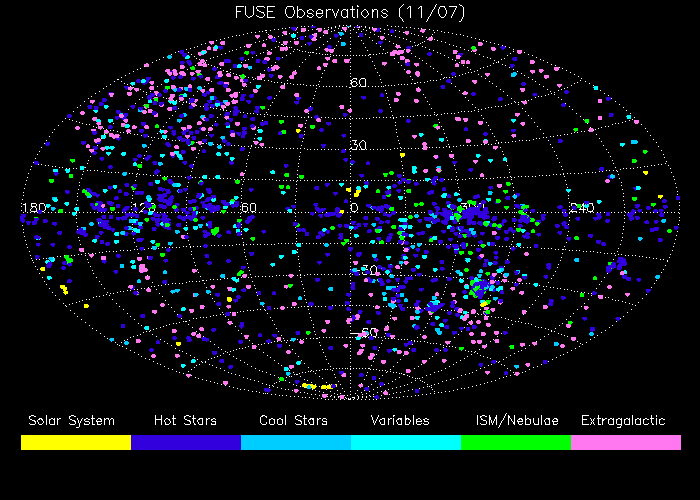
The Far Ultraviolet Spectroscopic Explorer (FUSE), was launched June 24, 1999, and was decommissioned on October 18, 2007, after failure of the pointing system on the satellite. The Canadian and French space agencies were partners with NASA in designing and operating the FUSE Mission. FUSE was operated for NASA by the Henry A. Rowland Department of Physics and Astronomy at the Johns Hopkins University.Over eight years of operations, FUSE acquired over 6000 observations of nearly 3000 separate astronomical targets. All the archived data is now public and no longer requires user registration. Astronomers used FUSE to observe a tremendous range of object types, from planets and comets in our solar system to hot and cool stars in our Milky Way and nearby galaxies, and even to distant active galaxies and quasars. However, FUSE's real claim to fame was its ability to sense and diagnose the physical conditions in the tenuous regions of interstellar and intergalactic space, regions that are often considered to be empty!
For more information, read the Mission Overview or use the menu at left to navigate the site.
 |
|
||||||||||||||||||||

|
|
|
|
|
|
|
|
|
|